
Why the ribcage wrap transforms newborn breastfeeding
Why does the ribcage wrap matter so much when your baby is little?
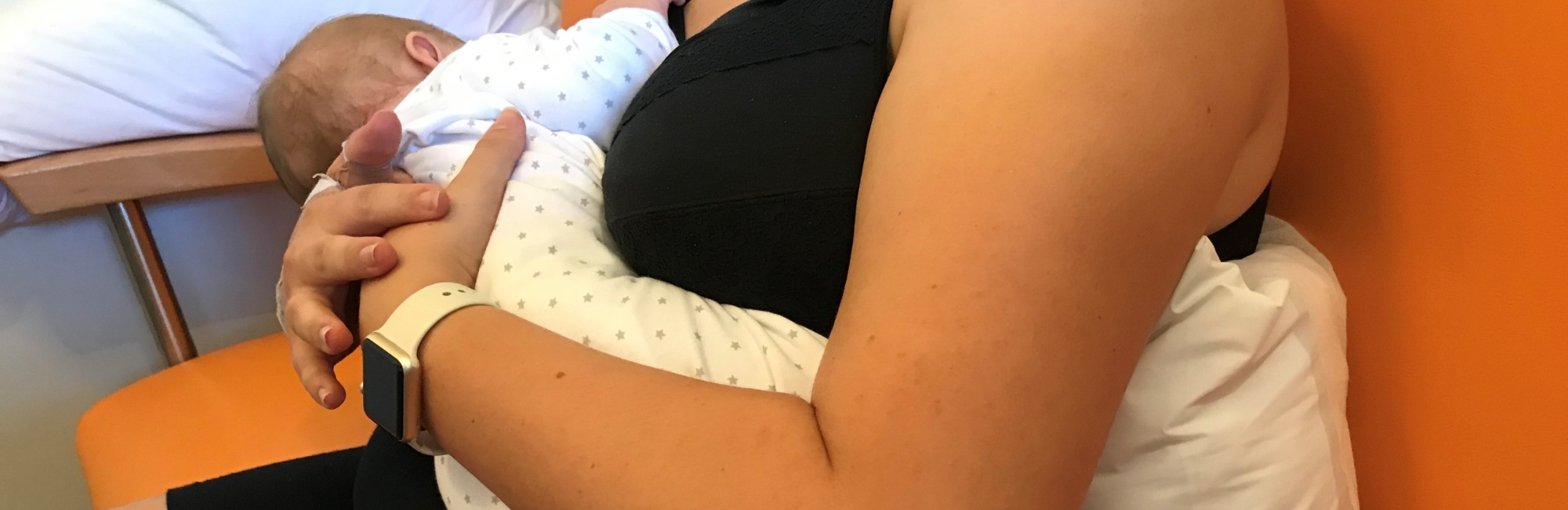
The ribcage wrap allows you to breastfeed safely and free of pain regardless of a caesarian section wound and regardless of the shape of your tummy, which is likely to be soft and round for some time after the birth. (Actually, most us have bellies which are soft and round the whole of our lives. That’s normal!)
If your baby is lying over the lovely round mound of your tummy, his head and neck are more likely to be tilted forward (or flexed) at the breast, which makes it harder for him to come on and feed because
-
His little nostrils block off. If he can’t breathe through his nose, he’ll keep on pulling off your breast.
-
He's trying to feed with nipple and breast tissue drag. This results in nipple pain, or baby fussing at the breast.
To my mind, these biomechanical challenges, which will depend on each unique mother-baby pairs anatomies, are why the research shows that ‘baby-led breastfeeeding’ or ‘biological nurturing’ has only a very modest effect on nipple pain preventatively, and has not been shown to help remedy nipple pain or latch problems. (Although biological nurturing is said to be baby-led, in practice women actively help their baby into the biological nurturing position, which is also sometimes called a koala hold or straddle hold.)
But as soon as you tuck your newborn right up under your other breast, with the non-feeding breast resting on baby’s little body, it’s much easier to get the angles of the face-breast bury right. If baby’s tummy rests on the pillow of the other breast, we still have the angle problem. In my experience, the ribcage wrap helps most women and their newborns breastfeed effectively most of the time, when integrated with the range of other gestalt strategies.
As one father of a baby who was causing his mother substantial nipple pain enthused to me, “It’s really all about the engineering, isn’t it!” (He was, needless to say, an engineer.)
The ribcage wrap is best for newborns but doesn’t work as baby grows longer
As your baby grows older and longer, the ribcage wrap turns into a diagonal across your body, with baby’s hip resting on your lower abdomen and thigh. As baby grows out of the newborn period, it becomes too awkward to have her under your breast. For example, she’ll start kicking off the back of your chair, worsening any nipple and breast tissue drag.
But in the beginning, in my clinical experience, the ribcage wrap is remarkably helpful for most women who have breastfeeding problems.
Selected references
Milinco J, Travan L, Cattaneo A, Knowles A, Sola VM, Causin E, et al. Effectiveness of biological nurturing on early breastfeeding problems: a randomized controlled trial. International Breastfeeding Journal. 2020;15(1):21.
Svensson KE, Velandia M, Matthiesen A-ST, Welles-Nystrom BL, Widstrom A-ME. Effects of mother-infant skin-to-skin contact on severe latch-on problems in older infants: a randomized trial. International Breastfeeding Journal. 2013;8:1.
Wang Z, Liu Q, Min L, Mao X. The effectiveness of laid-back position on lactation related nipple problems and comfort: a meta-analysis. BMC Pregnancy and Childbirth. 2021;21:248.
Yin C, Su X, Liang Q, Ngai FW. Effect of baby-led self-attachment breastfeeding technique in the postpartum period on breastfeeding rates: a randomized study. Breastfeeding Medicine. 2021;April 27:doi: 10.1089/bfm.2020.0395.