
Research about induction of lactation in transgender patients
Trahair et al Durham 2024: summary
Background
This case report concerns a 50 year old assigned-male-at-birth transgender woman with medical history of discoid SLE and antiphosophlipid antibody, a surgical history of simple bilateral orchiectomy (2018), and full depth vaginoplasty (2019). No cigarette smoking, minimal alcohol.
-
Taking oestradiol 0.3 mg transdermal patch every 72 hours and micronized progesterone 200 mg oral once daily. Taking hydroxychloroquine sulfate daily.
-
Wished to breastfeed expected grandchild, and presented close to the daughter's due date.
-
Wished to experience the bond from breastfeeding, a desire which was supported by her daughter.
Management
-
Extensively counselled on increased risk of venous thromboembolism due to higher estrogen levels, age greater than 40, hypercoagulable disorder.
-
Started with increase estradiol dose to 0.4 mg transdermal patch every 72 hours, started manual pumping and nipple stimulation 3-4 times per day in five minute increments. Progesterone increased from 200 to 300 mg daily. Prescribed metoclopramide 10 mg tds. Advised to start this one month after commencing estrogen and progesterone.
When this patient began to pump 5-6 times daily for 45 minutes per session, she started to experience spontaneous letdowns of milk, removing a few drops of milk daily three weeks after adding domperidone.
She lactated for a total of two weeks and nursed the four month old infant on multiple occasions, with a peak milk production of 30 ml from larger R breast, 8 ml from smaller left breast. The patient noticed breast maturation and filling in because of her treatment.
The patient reflects on her experience
This patient decided to stop due to logistical barriers, such as needing to help with grandhild while daughter was pumping. She felt the breastfeeding from induction was a special experience, giving her female gender affirmation and full breast maturation.
Ikebukuro et al 2024, Japan: quotes and summary
Background
There have been recent reports of lactogenesis in cissgender women who have had children through adoption or surrogacy. This study is only the seventh case report of induced lactation in transgender woman found in the research literature. The patient was a 50 year old transgender woman undergoing hormone therapy who asked to co-feed baby with her pregnant partner.
The patient presented with her cisgender female partner in 19th week of pregnancy, conceived by sperm donation.
-
The patient had started hormone therapy at age 40, and was currently taking estradiol 6 mg/day.
-
She underwent orchidectomy at age 44.
-
Her hormone levels were in the female cisgender range for estradiol, progsterone, and prolactin, with some insulin resistance.
-
FBC lipids, E&LFTs nad
-
The patient was living with obesity. She had repeated normal ECGs prior to and during induction.
Induction process
A regimen of estradiol, progesterone, and domperidone was initiated, accompanied by nipple stimulation. Treatment commenced with 6 mg estradiol and 10 domperidone.
There were concerns about the risk of leg venous thrombosis with high-dose estrogen and also about possible QTc abnormalities associated with domperidone, so careful monitoring occurred throughout induction, including by ECG. Blood tests were performed as an adjunct to screening for thorombosis by measuring D-dimer.
-
On day 39 after presentation, the patient commneced 100 mg progesterone.
-
On day 46 commenced nipple stimulation (four times a day with breast pump, also 6 mg estrogen, 100 mg progesterone, 30 mg domperidone).
-
On day 53 progesterone was increased to 200 ml, and on day 59 progesterone (to 300 mg) and domperidone (to 60 mg) were increased, estraodiol 6 mg continued.
-
Day 63 added in 1 mg estradiol gel 500 mg progesterone 60 mg domperidone.
-
Lactation was confirmed on day 63.
-
Frequency of pumping increased to six times daily on day 99 and total oestrogen dose increased to 8 mg (2 mg gel). Pumping was increased to a total of 10 minutes each side. Transdermal estrogen was added to bring oestrogen concentration close to that of cisgender oestrogen concentration at that same gestational age. Transdermal rather than oral administration was chosen for estrogen administration to mitigate high risk of estradiol-induced venous thromboembolism.
-
Subsequently increased to 8 mg estradiol, 500 mg progesterone, and 80 mg domperidone daily. Adjusted domperidone levels were adjusted to maintain prolactin levels above 100 ng/l.
-
Progesterone was discontinued on day 123 of teratment and estrogen dose reduced to 4 mg. Domperidone 80 mg continued to maintain hyperprolactinemia.
-
After day 123 as progesterone and estrogen levels decreased, milk secretion increased to 30 mls milk/day.
-
Baby was delivered on day 146. The patient reported 30 mls/milk production per day, 63 days after initiation of hormone therapy.
-
On day 237, 3 months post delivery, domperidone was tapered and breastfeeding discontinued after 3 months of direct breastfeeding. The patient reported that her hypoestrogenic and hyperprolactinemiac state was taxing.
Analysis of milk composition
Milk composition analysis showed protein very high at 123 and 126 days after start of treatment, high sIgA lactoferrin; and calcium and zinc levels comrable with normal. That is, this patient's breastmilk composition was comparable with milk produced by mothers of preterm infants.
Van Amesfoort 2024, The Netherlands: quotes and summaries
Background
37 year old transgender woman (assigned gender male at birth, she/her) and her cisgender female partner presented asking that the patient be assisted to induce lactation.
- The main motivation for lactation induction was to enhance parent–child bonding. Furthermore, the couple were planning to alternate chestfeeding to limit the burden, because the pregnant "partner was experiencing some physical limitations".
"The patient’s medical history was notable for gender incongruence. Hence, she was using gender affirming hormone therapy since October 2007 and had undergone a vaginoplasty in 2010, which was revised in 2011 and 2012. Her surgical history was also significant for an appendectomy because of appendicitis in 2010. The patient’s history was negative for smoking, alcohol and drugs.
Prior to initiating gender affirming hormone therapy she had cryopreserved her semen, which she and her partner used for her partner to conceive. At the time of her visit to the clinic she used estradiol gel 75ug per day, once daily."
"Low milk production, and thus the possible inability of exclusive nursing were discussed with the patient. Hence, by shared decision making, our patient chose non-puerperal lactation induction."
Proposed treatment regime for transgender women who choose to induce lactation
Van Amesfoot et al propose a treatment regime for transgender women who wish to induce lactation.
-
Intake appointment in clinic before conception or in first trimester. Analyse risk factors, allergies, blood hormone levels
-
At end of first trimester (12-13 weeks gestation), after confirmation of viable pregnancy, increase estrogen dosage to 150 mcg once daily and commence progesterone 100 mg once daily. This is ideally started 3-5 months prior to expected due state. Start manual stimulation of breast tissue by massaging, nipple stimulation. Discuss referral to a lactation consultant.
-
At 17-18 weeks gestation, monitor blood hormone levels, increase estrogen to 250 mcg once daily
-
At 20 weeks gestation, start domepridone 10 mg qid
-
At 21 weeks, double domperidone
-
At 23-24 weeks gestation monitor blood hormone levels, increase progesterone to 100 mg two times daily. Adjust estrogen dosage according to blood hormone levels
-
At 27-28 weeks of gestation monitor blood hormone levels, increase progeserone to 100 mg three times daily. Adjust estrogen to blood hormone levels
-
At least six weeks before expected due date, start manual breast pumping of breast to at least every 3-4 hours, at least once nightly
-
4-6 weeks before EDD decrease estrogen dose to 100 mcg once daily and discontinue progesterone
-
At onset of milk production decrease estrogen dosage to 50 mcg once daily. Use electric pump when milk volume increases
-
After bith continue pumping including after feeds. "Supplemental feedings with infant formula might be necessary."
Induction process for reported case
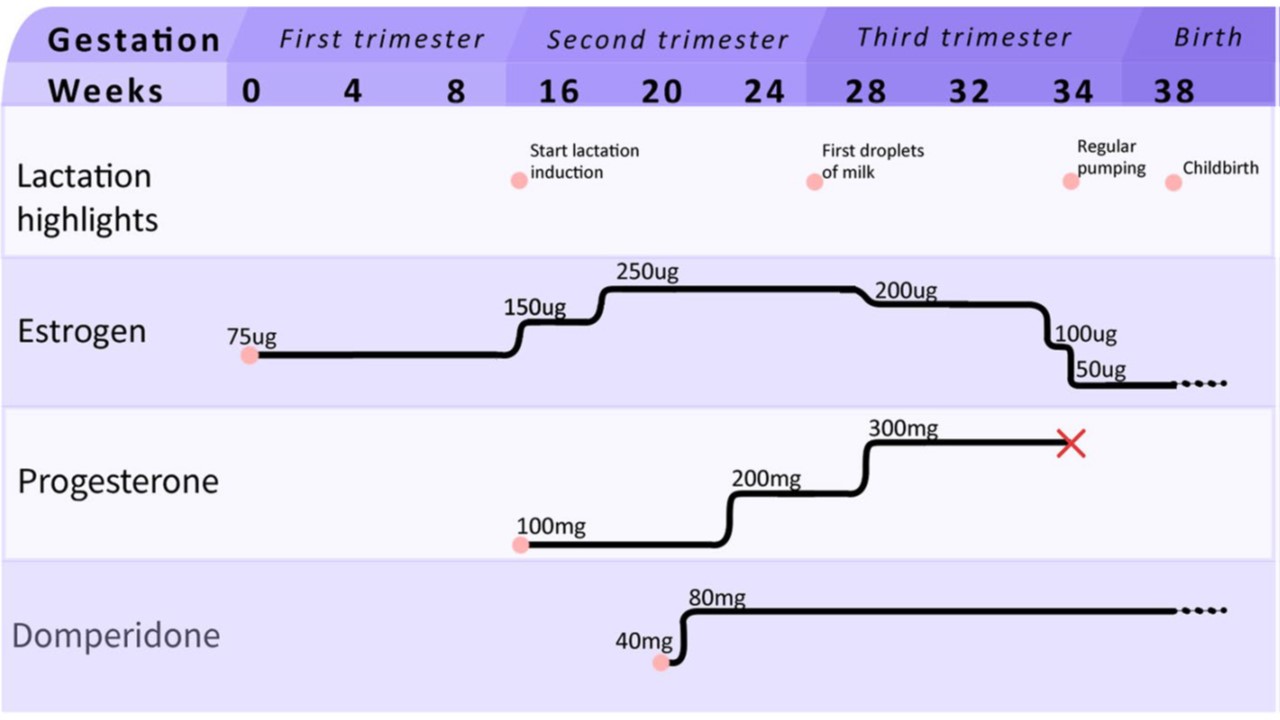
This study reports on a case of conception by cryopreserved sperm of a transgender woman (assigned male gender at birth AMAB, affirmed gender is female) and Intracytoplasmic Sperm Injection of the patient's cisgender female partner.
The patient using estradiol gel 75 mcg daily at presentation. Laboratory investigations were conducted re hormonal levels. On 1st June 2020, when her partner was approximately 14 weeks gestation, the patient started non-puerperal lactation induction.
-
The first step was the use of a 150ug estradiol adhesive dermal patch once daily and 100 mg progesterone once daily orally. Figure 1 copied this publication summarises highlights in the treatment regime used, above.Laboratory follow up was arranged after one month.
-
After three weeks, two pumps estradiol dermal spray (which equals approx 100mcg estradiol adhesive patch) added to estradiol treatment. Patient also started manual stimulation of the nipples and breast
-
Six weeks in, she started domperidone 10mg four times daily orally
-
Seven weeks in, domperidone dose doubled to 20 mg four times daily.
-
Eight weeks in, progesterone dosage doubled to 100 mg twice daily orally.
-
Patient had gastrointestinal discomfort due to use of domperidone, which decreased over time.
-
Lactation consultant focussed on education about massaging of the breasts, pumping techniques, routines.
-
At nine weeks patient expressed first drops of fluid from her nipples. Laboratory results showed that serum estradiol levels were high, so estradiol treatment decreased by 50 mcg to total of 200 mcg estradiol daily. Progesterone increased to 100 mg three times daily. Further lab investigations a fornight later - at 11 weeks in.
-
Four months in, estradol dosage decreased by stopping the transdermal spray, so patient was now taking a daily dosage of 100 mcg estradiol daily.
-
One week later progesterone discontinued and patient started pumping every four hours including through night. A few droplets of milk released every time she pumped, to 2ml milk per day. The estradiol treatment decreased to 50mcg daily.
-
Investigations were undertaken at 0, 10 days, 9 weeks, 11 weeks for estradiol, progesterone, testosterone, prolactin. At Week 0 clinicians also checked ASAT (SGOT), ALAT (SGPT), creatinine, cholsterol.
When their infant was birthed by her partner, both parents continued or commenced pumping. Patient produced a maximum of 7 mls a day, enough for supplementary feeding. The infant had a short lingual frenulum and suckling problems. Patient weaned two weeks after birth because she experienced the frequent pumping to be exhausting and milk production to be low. Two weeks after the birth her estradiol dosage was increased to 100 mcg.
Patient reflections
The patient reported that lactation induction did not have a significant effect on her gender identity, nor alter gender dysphoria. She reported, in her words, that it was a pity that the experience of long-term feeding had not been possible. She reported that she had fed a few times (to comfort the baby).
Authors' reflections
The authors note that
-
Although this patient started manual stimulation and expression 20 weeks prior to delivery, she only began using the breast pump three weeks before delivery (had meant it to be five weeks; baby arrived at 38 weeks.) Most people advise six weeks of pumping.
-
Prenatal development of mammary tissue is similar in both males and females. In cisgender women breast development starts at pubery under influence of estrogen. The breasts of transgender women are indistinguishable from cisgender women on radiography. However, clinically transsgender women may have smaller breast which may not reach full breast maturity, similar to Insufficent Glandular Tissue.
Weimar 2023 California, USA: quotes and summary
"For transgender and gender-diverse (TGD) parents, the ability to nourish their infants through production of their own milk may also be a profoundly gender-affirming experience."
Background
A 46 year old transgender woman (assigned male gender at birth) presented for induction of lactation 4 months prior to her pregnant partner's due date. She had been on gender-affirming hormone therapy since 27 years of age, and at the time of presentation was taking sublingual estradiol 2 mg bd.
The patient was "a nonsmoker and had no family history of venous thromboembolism. She took no other medications, including specifically over-the-counter medications which may prolong the QT nterval. Her physical examination at the initial consultation for lactation induction showed mature A-cup breasts with full rounded contour and excellent nipple maturation and protrusion."
Induction of lactation
The participant increased her estradiol dose and started progesterone and domperidone 107 days prior to the baby's due date. An estradiol dosing of 4mg twice daily was selected to be relatively pharmacologically equivalent to the recommended ethinyl estradiol dose of 35mcg daily in the Newman-Goldfarb protocol (Newman 2002-2019). On day 107 she started 100 mg progesterone daily, and domperidone 10 mg qid. "After 13 days, doses of domperidone and progesterone were increased to maximize effect" - domperidone to 20 mg qid; progesterone to 200 mg daily.
The patient "underwent a diagnostic mammogram with ultrasound three weeks after initiation of the lactation induction protocol, both for routine breast cancer screening, as well as [to investigate the] new development of right axillary discomfort. Images were notable for extremely dense breast tissue and were otherwise normal. Axillary discomfort spontaneously improved."
"At 6 weeks prior to the DD ... she was instructed to stop progesterone, switch to low-dose (25 mcg/day) transdermal estradiol, continue domperidone, and start pumping with a goal of six 15-min sessions per day."
"At approximately 14 days after delivery, once the gestational parent's breastfeeding was well established, the participant started directly breastfeeding the infant once or twice daily with good success, and a bottle of her pumped milk was periodically offered. She continued to store approximately 150 ml daily over two pump sessions, in addition to direct breastfeeding one or two times daily. ... The participant decreased the domperidone to 20 mg three times daily ... continued this dose for the remainder of her breastfeeding. ... At approximately 4 months following delivery, the participant desired to stop breastfeeding. ... She weaned off the domperidone over 1 week without adverse effects and resumed her previous dose of sublingual estradiol 2mg daily."
The patient reported that induction of lactation brought pragmatic and emotional benefits - and helped the family manage sleep and fatigue.
The authors reflect on the case
Though the experiences of breast or chest feeding transgender and gender diverse parents (TGD) have much in common with those of cisgender people, there are unique considerations including
-
Need for appropriate and affirming language
-
Management of gender-affirming hormone therapy during the process.
Because the participant expected to have minimal endogenous production of estradiol as a result of prior orchiectomy, rationale for continuing low-dose estradiol treatment during period of milk production was to minimize adverse effects, especially mental, from discontinuation of oestrogen treatment altogether, whilst avoiding impact on milk production.
Spironolactone or antiandrogen therapy was not indicated.
Weimer et al assessed the participant's milk and found values of fat, lactose, protein and calorie were comparable or even higher than those in term milk produced by cisgender women.
Delgado et al 2023, California USA: quotes and summaries
Abstract excerpt
"A growing number of diverse familial structures wish to colactate their infant. For transgender and gender diverse (TGD) individuals, chestfeeding or breastfeeding may be within their goals of parenthood. There is limited evidence on how to induce lactation for a nongestational parent on gender affirming estrogen treatment."
"We report the case of a transgender woman who successfully underwent lactation induction following a protocol using the galactogue domperidone plus use of a breast pump. The patient had modifications to her hormone therapy with estrogen and progesterone while remaining on antiandrogen therapy with spironolactone. This study contains a description of the protocol, medications, laboratory monitoring, human milk analysis including macronutrients, oligosaccharides, and hormones."
Background
"There are a growing number of families formed by gender and sexual minorities. However, unfortunately the topics of pregnancy, childbirth, and parenting have often been bound to heteronormative norms and assumptions.For transgender and gender diverse individuals, this can be compounded by a history of stigma and marginalization in health care."
"Many diverse familial structures may have two parents who desire to colactate."
It's important to utilize gender inclusive language, varying from chestfeeding or breastfeeding as desired by the parent.
"For transgender women on gender affirming treatment, the breast tissue develops radiographically and histologically indistinguable from cisgender women. The tissue goes through typical pubertal changes with estrogen called Tanner stages, leading to a breast tissue capable of lactating."
A 40 year old transgender woman presented with her cisgender wife, due date 6 months in future, hoping to assist her wife with breastfeeding.
-
Had been on gender affirming hormone therapy since 35 years of age, currently on sublingual estradiol 4 mg twice daily, spironolactone 100mg bd, and progesterone 200 mg at bedtimes.
-
On physical examination her breasts were Tanner stage V with semiretracted nipples bilaterally. [Tanner scale stage 5: The areolar mound recedes into a single breast contour with areolar hyperpigmentation, papillae development, and nipple protrusion.]
Overview of the induction process
-
In the initial consultation lactation induction protocols reviewed and galactogue use discussed - domperidone counselling on risk of prolonged QTc with medication, requirement for ECG every 2 months. Blood tests ordered and monitoring scheduled.
-
Commenced domperidone. Increased estradiol SL to 6 mg bd and progesterone to 400 mg bedtime, continue on antiandrogen regimen.
One month followup:
-
ECG QTc normal
-
Spironolactone decreased to 100 mg daily and domperidone doubled.
-
Six weeks before due date medications were changed to mimic delivery, including switching to transdermal estradiol and stopping progesterone. Encouraged to use electric pump every 3 hours for at least 5-7 minutes on each breast, or at least 6 sessions per day. Lactation consultant helped fit breast pump.
-
Baby born 4 days early by CS. Wife breastfed exclusively with patient assisting through bottle feeding. Patient able to give her baby at least one bottle of her own induced milk daily. Baby also needed formula feeding.
-
Patient had daily milk production of 74 ml. Milk production decreased in initial postpartum period due to caring for wife and baby. Milk supply increased with increased pumping. Began to breastfeed once daily. Continued domperidone throughout course of lactation for at least 5 months.
-
7 month follow up, 14 days postdelivery, patient expressed wish to increase estrogen and sprionolactone back to pre-induction levels, which she did incrementally and which did not impact on milk. Milk volume peaked at 240 ml daily 3 months after birth as she continued to pump and breastfeed regularly.
Analysis of milk composition
Two months post birth milk collected for analysis. Values of protein, lactose, fat and calorie content were at or above standard term milk. HMO concentrations within normal mean range of mature human milk. Insulin, leptin, FGF-21 levels variable over the 8 weeks, but in line with previous studies. LH and FSH were undetectable.
Author comments
Dropping estrogen levels and antiandrogen doses can increase the testosterone levels inducing gender dysphoria. Patient in this case continued to take spironolactone at a lower dose. When estrogen levels dropped, she did report rising dysphoria and increased the antiandrogen to achieve an estrogen predominant hormonal milieu. This was not accompanied by immediate change in milk volume but longer term effects of above changes were not clear.
More articles in module 'Synchronising breastmilk production with infant caloric need', section title 'Non-puerperal induction of lactation'
Taking a history when your patient requests induction of lactation and why each question matters.pdf
Research about induction of lactation in transgender patients
NDC Co-lactation Feeding Plan (please adapt for your patient).docx
Case report of preparation for induction of lactation in a cisgender woman (NDC Clinical Guidelines)
Selected references
Delgado D, Stellwagen L, McCune S, Sejane k, Bode L. Experience of induced lactation in a transgender woman: analysis of human milk and a suggested protocol. Breastfeeding Medicine. 2023;18(11):888-893.
Ikebukuro S, Tanaka M, Date M. Induced lactation in a transgender woman: case report. International Breastfeeding Journal. 2024;19(66):https://doi.org/10.1186/s13006-13024-00675-13004.
Trahair ED, Kokosa S, Weinhold A. Novel lactation induction protocol for a transgender woman wishing to breastfeed: a case report. Breastfeeding Medicine. 2024;19(4):DOI: 10.1089/bfm.2024.0012.
Van Amesfoort JE, Van Mello NM, Genugten RV. Lactation induction in a transgender woman: case report and recommendations for clinical practice. International Breastfeeding Journal. 2024;19(18):https://doi.org/10.1186/s13006-13024-00624-13001.
Weimer AK. Lactation induction in a transgender woman: macronutrient analysis and patient perspectives. Journal of Human Lactation. 2023;39(3):488-494.