
How to pump your breast milk as easily and effectively as possible: wearable and non-wearable pumps
What do you need to know about non-wearable (or traditional) pumping equipment?
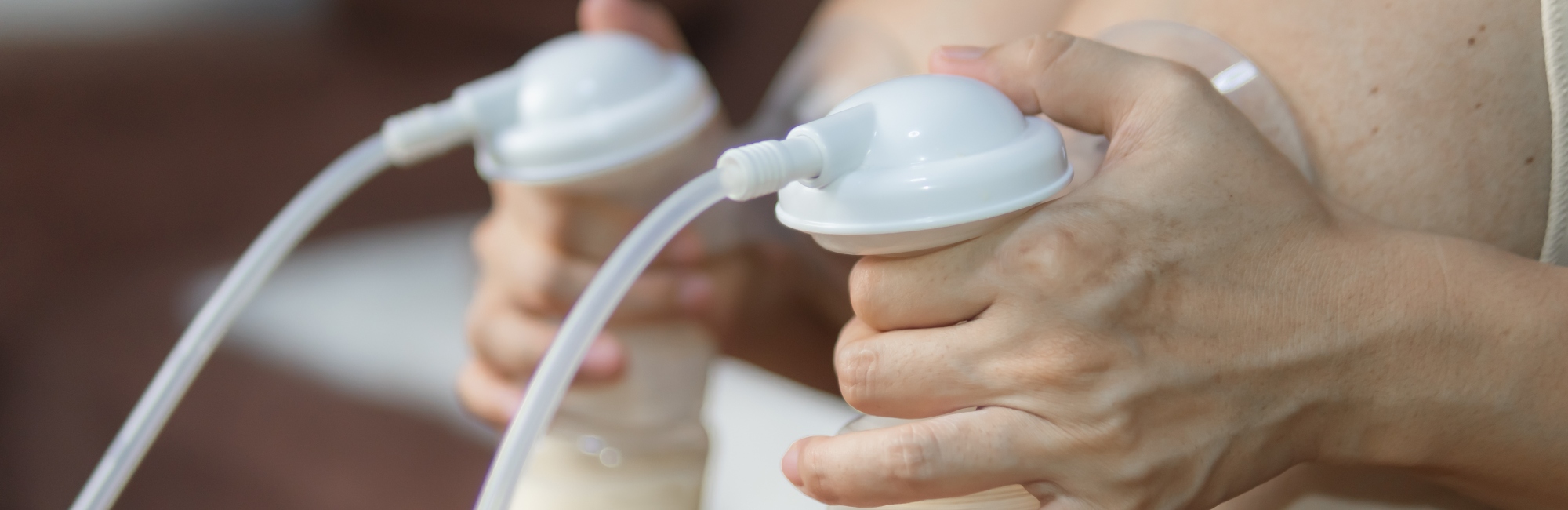
If you are needing to pump, it makes sense to do this as efficiently as possible, with a high quality, double-flanged, motorised pump. Double pumping produces the highest milk yield, and releases more oxytocin.
-
I don't recommend purchasing single-flanged pumps or hand pumps. If you need a temporary back-up and don't have access to a mechanical pump (either borrowed, rented, or purchased), you might express your milk with your hands. You can find how to do this here.
-
I also don't routinely recommend purchasing a breast pump before you've given birth, because most women can directly breastfeed their baby without needing one. There is time to think about pumping for return to paid work, for example, as the weeks pass. But in some countries it can take some time to get hold of pumps if you do need one early on in your baby's life. Also, in the USA, pumps are available through health insurance in pregnancy. Other women know they need to return to paid work shortly after the birth, and need to be prepared.
If you run into breastfeeding problems, you may need to quickly hire or purchase a pump to maintain your milk supply.
The research has found no consistent difference between prolactin changes or effect on oxytocin release with pump type or method. Mechanical breast stimulation is followed by a rise in oxytocin similar to suckling.
What do you need to know about wearable breast pumps?
Hands-free, wearable pumps can be wonderfully convenient if you're needing to pump, and especially if you're needing to pump whilst performing paid work or caring for other children. Increasingly, high quality wearables are becoming the norm for women who need to do quite a lot of pumping.
But there are downsides. Once you're aware of these, you'll be able to use your wearable pumps in a way that protects your breasts as you get through the days and nights with your baby.
What are the downsides to wearable pumps?
Wearable pumps
-
Have less strong pumps, and usually don't achieve the same milk output. Some of the newer and typically more expensive brands of wearable pumps are showing improved pump strength.
-
May cause moisture-associated skin damage of the nipple, which predisposes to nipple pain and damage with direct breastfeeding. You can find out about this here.
-
Breast inflammation (or mastitis) from the pressure of the wearable pump on your milk ducts, 60% of which are within a three centimetre radius of the base of your nipple. Your milk ducts are very easily compressed, resulting in a building backpressure of milk in the glands. You can find out about this here.
-
Overstimulation of your supply so that you are producing more breast milk than your baby needs on any day, which also places you at risk of breast inflammation.
-
Some breast-belly contours don't fit as well with wearable pumps, and maintaining the seal becomes quite difficult.
The Australian Breastfeeding Association endorses the China-based Lacevo S70 wearable breast pump, promoted as solving these common problems. There is no peer-reviewed and published research to support this claim, but I have heard positive feedback in the clinic.
If you already have nipple pain or damage, a wearable breast pump may make it more difficult for you to control and eliminate breast tissue drag during pumping, in which case it's best to use a non-wearable pump with bottles to collect your milk. This way, you can carefully support the bottles throughout the pumping session, to protect your nipples and breasts as best you can from too much stretching pressure focussed on the one area, and from mechanical microtrauma. It's more time intensive, but it's better in the long run to keep your nipples as free from damage and inflammation as possible.
What are the best settings to use?
You'll likely find yourself experimenting with breast pump settings over time. Settings are generally best kept as high as is comfortable - it's important to be comfortable so that your nipple and breasts are protected from damage. Women usually settle for the maximum setting which is still comfortable. Whilst its tempting to think that you'll get more milk if the suction pulls harder, in fact most milk is transferred when your breasts are comfortable. If you already have nipple pain or damage, you'll likely need to use a very low setting.
It's true that a setting may be so low that it doesn't extract your milk, and getting the balance right can be challenging. However, higher settings can damage your nipple by applying intense stretching forces to a small surface area of your nipple, and might also elongate and compress ducts rather than facilitate more milk transfer.
The letdown or massage phase (which is about 70 pulls per minute) might suit you all the way through your pumping session. Or you might change to the expressing phase (about 54 pulls per minute), finding that slower is better for your milk expression or your comfort.
You can find a clear discussion about breastpump settings here.
Recommended resources
When does pumping of your breasts help with breastfeeding?
What timings work best if you're pumping your breast milk?
How to protect your nipples and breasts from injury during pumping
When might pumping get in the way of direct breastfeeding your baby?
Why triple feeding andthe top-up concept can get in the way of successful breastfeeding
How to transition from formula use to exclusively or predominantly direct breastfeeding
You can find out about expressing and storing your breast milk on the Australian Breastfeeding Association's website, here.
Selected references
Gridneva Z, Warden AH, McEachran JL, Perrella SL, Lai CT, Geddes DT. Maternal and infant characteristics and pumping profiles of women that predominantly pump milk for their infants. nutrients. 2025;17:366.
Rosenbaum K, McAlister B. An integrative review of exclusive breast milk expression. Journal of MIdwifery and Women's Health. 2024:doi:10.1111/jmwh.13713.