
How to protect your nipples and breasts from injury during pumping
Using a pump with a collecting bottle on the other breast while direct breastfeeding, as shown in this photo above, can interfere with fit and hold and worsen breastfeeding problems.
How to protect your nipples and breasts when you're using a traditional or non-wearable breast pump
Standard non-wearable pump flanges are made of a plastic funnel which meets the tunnel at the ring. The size of the flange is measured at the ring. Your nipple expands in both length and diameter in response to application of a vacuum (whether by baby's suckling or by the mechanical pump). The amount of this nipple expansion will vary from woman to woman.
You'll often hear it said that the flange should be four millimetres more in diameter than the diameter at the base of your own nipple. But this is not helpful advice, because women's nipples expand variably in response to vacuums. It's more helpful to measure the width of the face of your nipple (not base) and then experiment with that flange size, as well as one size down, and also one size up, to see what feels best for you.
If you are feeling discomfort or running into problems pumping your milk, I recommend you experiment with two or three different sized flanges, to see which feels best. Check the following when you are pumping.
-
Make sure your nipple does not rub a lot against the wall of the tunnel (which causes nipple inflammation or pain). If your nipple is pressing up against the flange inside the tunnel a little, but you are feeling completely comfortable and painfree, that's ok. It's worth noting that the standard mechanism of pulling in the nipple alone is different to the way a baby breastfeeds, which is to draw up quite a lot of the breast tissue as well as the nipple into the mouth, distributing the mechanical load of the vacuum over as wide a surface area as possible. You can find out about baby suck in breastfeeding here.
-
Make sure your areola is not being drawn up into the tunnel (which causes areola inflammation pain, and even deep bruising). Often a red irritated rash develops on the areola if your areola is being repetitvely drawn up into the tunnel, with a clearly demarcated border to the rash that corresponds with where the ring of the flange is rubbing.
-
Make sure you don't press the flange too firmly in against your breast, so that milk ducts are compressed. Just hold the flange in a light seal against the skin of your breast. Compression of breast tissue may compress your milk ducts, limiting milk transfer and putting you at risk of a mastitis.
-
Avoid using a traditional breast pump while you're breastfeeding your baby on the other side. This is also true of the traditional haakaa pumps, which have a bottle for collecting milk. If you don't have any breastfeeding problems and are wanting to collect some milk to store in the fridge for when you're not there, it might work for you to use them sometimes. But if you have any problems at all with breastfeeding, then it's important not to try to pump from the other breast with traditional collecting bottles while breastfeeding. A haakaa ladybug milk collector, or a wearable pump, are less likely to interfere with fit and hold.
Other ideas for protecting your nipples and breasts during pumping with a traditional breast pump
You could try
-
Olive oil in the flange if you are feeling discomfort due to rubbing on the ring (unless you have an allergy to olives).
-
A pump cushion (such as here) if you are feeling discomfort during pumping. However, your nipple needs to move freely through the hole in the cushion without rubbing against the wall of the hole through the cushion, and without having your areola drawn into the hole. Cushion inserts may be particularly useful if you notice you have a great deal of nipple and breast tissue elasticity or elongation during pumping.
-
'Pumpin' Pal' flanges, which have a taper in ring size between the flange and the tunnel. This taper aims to allow the areola and other breast tissue to be drawn into the flange, without rubbing on the flange.
-
Sometimes, if pumping if causing nipple pain, it can help to only use both flanges through first letdown. Then hand express one breast while you're pumping from the other, and change over next time.
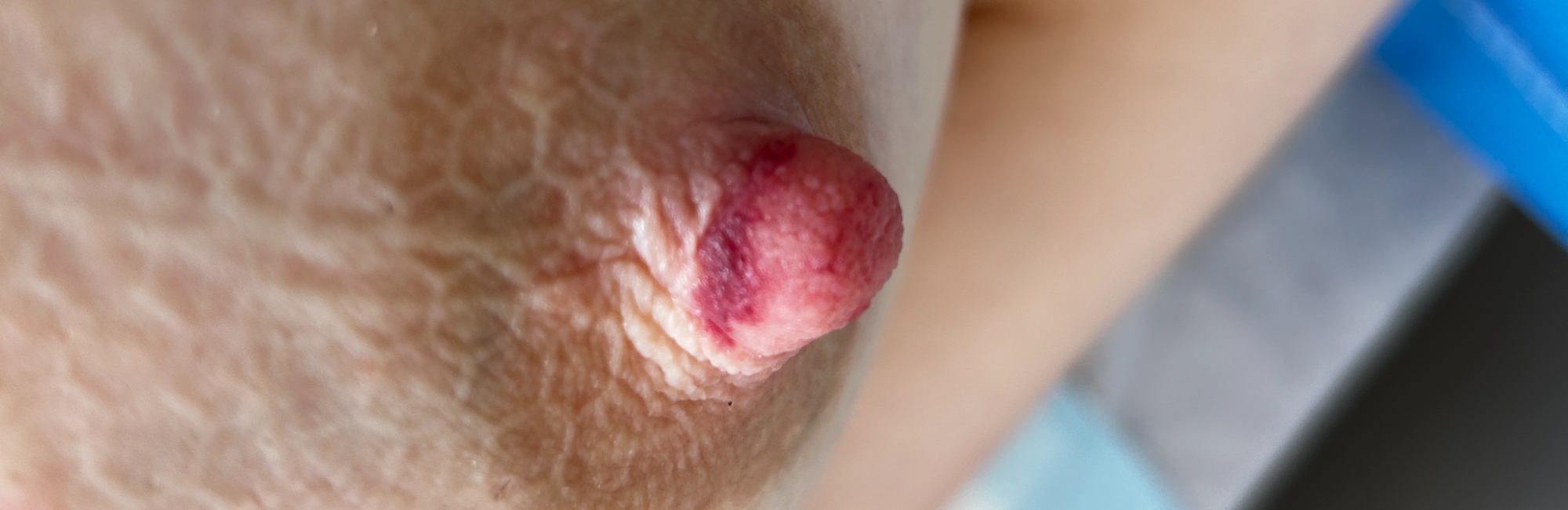
The lady in this photo, below, whose nipple is severely bruised (with bleeding under the skin) was exclusively pumping, and developed this damage incrementally, over time. We want to do what we can to prevent bruising or other nipple injury from pumping, particularly if needing to pump a lot.
Recommended resources
How to protect your nipples and breasts from injury during pumping: part 2 (video)
When does pumping of your breasts help with breastfeeding?
What timings work best if you're pumping your breast milk?
When might pumping get in the way of direct breastfeeding your baby?
Why triple feeding andthe top-up concept can get in the way of successful breastfeeding
How to transition from formula use to exclusively or predominantly direct breastfeeding
You can find out about expressing and storing your breast milk on the Australian Breastfeeding Association's website, here.
Selected references
Anders LA, Frem JM, McCoy TP. Flange size matters: a comparative pilot study of the flange FITS (TM) guide versus traditional sizing methods. Journal of Human Lactation. 2024;41(1):54-56.
Gridneva Z, Warden AH, McEachran JL, Perrella SL, Lai CT, Geddes DT. Maternal and infant characteristics and pumping profiles of women that rpedominantly pump milk for their infants. nutrients. 2025;17:366.
Qi Y, Zhang Y, Fein S. Maternal and breast pump factors associated with breast pump problems and injuries. Journal of Human Lactation. 2014;30:62-72.
Rosenbaum K, McAlister B. An integrative review of exclusive breast milk expression. Journal of MIdwifery and Women's Health. 2024:doi:10.1111/jmwh.13713.